


Starter vs Ignition Failure and What Symptoms Mean
A vehicle that will not start creates pressure to guess. You turn the key or press the button, hear one click, several clicks, or nothing at all, and the first question is usually starter vs ignition failure. The symptoms can overlap, but the repair is not the same. Replacing a starter when the ignition circuit is not commanding it on wastes money. Replacing an ignition switch when the starter is worn out does the same.
At Village Auto Electric, we see this regularly: a vehicle arrives after a battery, starter, relay, or ignition part has already been replaced, yet it still will not crank. The answer comes from testing the entire starting circuit under the conditions where it fails, not from choosing the part that seems most likely.
Starter vs Ignition Failure: The Basic Difference
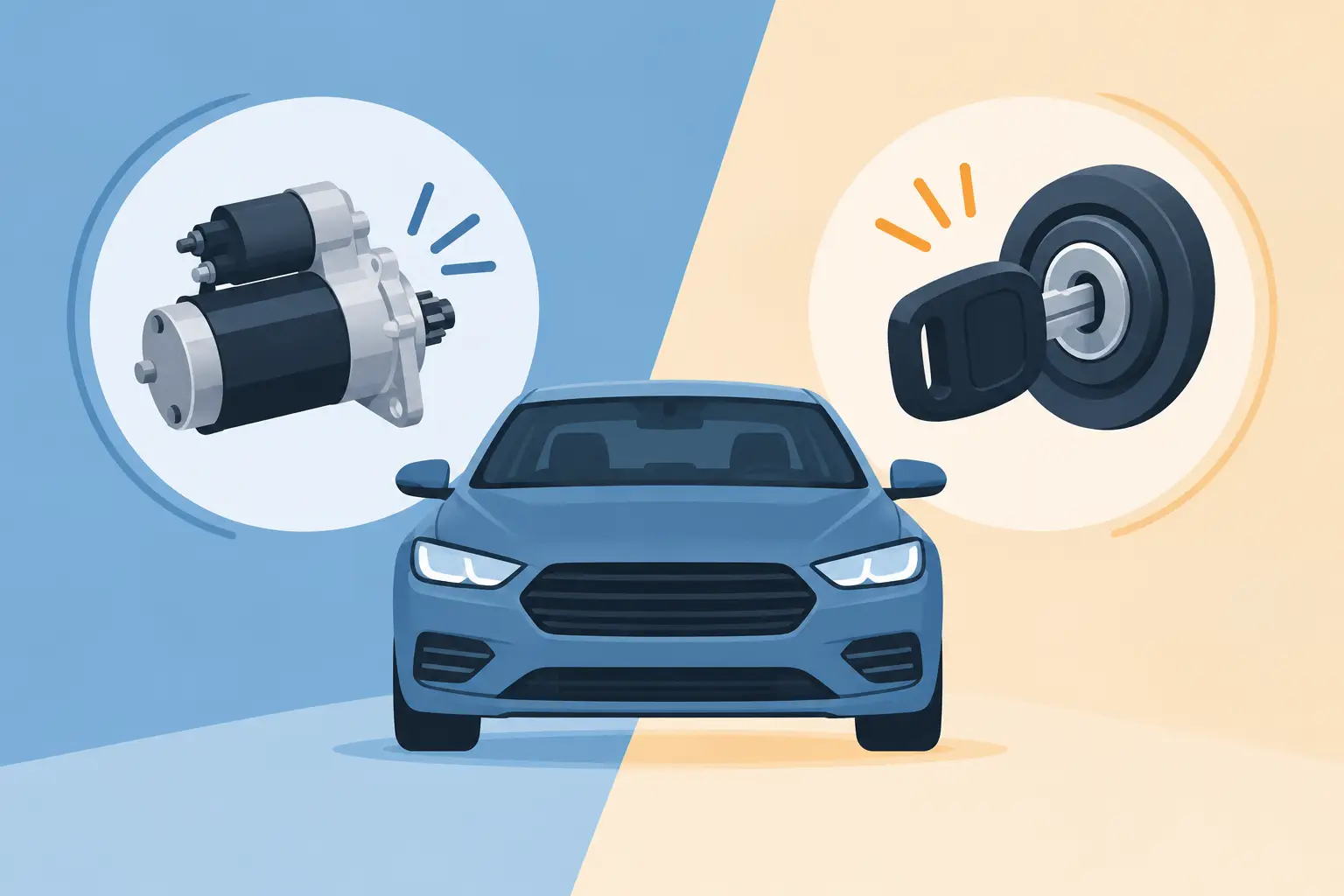
The starter is the high-current electric motor that turns the engine over. When you start the vehicle, the starter solenoid receives a command signal, engages the starter gear with the engine flywheel or flexplate, and sends battery power through the starter motor. A failed starter may click once, crank slowly, crank intermittently, or do absolutely nothing.
The ignition system, in the everyday sense, is the chain of controls that allows the vehicle to start. On older vehicles, that may center on the ignition switch and key cylinder. On late-model vehicles, the command can pass through the ignition switch or start button, brake or clutch switch, park-neutral switch, starter relay, body control module, engine computer, anti-theft system, and wiring before the starter ever receives power.
That is why a no-start condition is not automatically a bad starter. The starter may be perfectly capable of cranking the engine but never receive the signal required to do its job. Likewise, an ignition switch can send the correct command while a worn starter motor fails under load.
Symptoms That Point Toward a Starter Problem
A starter failure often becomes intermittent before it becomes permanent. The vehicle may start normally in the morning, then refuse to crank after a hot drive and start again after sitting for an hour. Heat can affect worn brushes, armature contacts, solenoid contacts, and internal connections inside the starter.
A single solid click when the key is turned to START can indicate that the starter solenoid is engaging but the motor is not spinning. That can point to a starter issue, but it can also be caused by weak battery power, corroded battery terminals, a poor engine ground, or excessive voltage drop in the cables. A click is a clue, not a diagnosis.
Slow cranking is another common complaint. If the engine drags as though the battery is low, test battery condition and charging history first. In Mesa heat, batteries can fail quickly and cable corrosion can hide inside an otherwise normal-looking terminal. If battery voltage, cable connections, and voltage drop are correct, the starter may be drawing excessive current or binding mechanically.
A technician can verify a starter problem by checking for proper battery power at the large starter terminal and a proper start command at the solenoid terminal while the failure is occurring. If both are present and the starter does not operate correctly, the starter is the likely fault. That is a testable answer, not a guess.
Symptoms That Point Toward an Ignition or Start-Control Problem
If there is no click, no crank, and no voltage at the starter solenoid command terminal when the key is held in START, the problem is usually upstream of the starter. The ignition switch may be involved, but it is only one possibility.
A vehicle that starts when the steering column is moved, the key is held in a certain position, or the key is jiggled can have a worn ignition switch, damaged connector, or mechanical issue in the key cylinder. On some vehicles, accessory power may work normally even though the start-contact portion of the ignition switch has failed.
Automatic-transmission vehicles may fail to crank because the system does not recognize Park or Neutral. If the vehicle starts in Neutral but not Park, the park-neutral switch, shifter adjustment, or related wiring needs attention. Manual-transmission vehicles can have a failed clutch safety switch that prevents the starter command.
Modern vehicles add more variables. A security light, key-shaped warning indicator, or message related to an immobilizer can mean the vehicle is not authorizing a start. A bad key transponder, key programming issue, antenna ring, body module fault, or communication problem can interrupt the crank request. Push-button systems may also require a valid brake-pedal signal before they will send a start command.
The difference matters because installing a starter will not repair a missing authorization signal. It may make the vehicle appear fixed briefly if a battery terminal was moved during the repair, but the original no-crank problem will return.
Why Battery and Cable Testing Come First
Starting systems demand far more current than most other vehicle circuits. A battery can show enough voltage to light the dash, operate the radio, and even power a scan tool while still collapsing under starter load. That is why a simple voltage reading does not tell the whole story.
The battery must be tested for condition and state of charge. The positive cable, negative cable, engine ground, and connections at the starter must be inspected and voltage-drop tested under load. A connection can look clean at the battery yet have corrosion under the insulation or inside the terminal. Poor grounds can create strange symptoms, including clicking relays, dim lights, intermittent no-crank conditions, and electronic warning messages.
Replacing a starter before confirming available current and proper cable integrity is backwards. A new starter cannot overcome a bad power feed or weak ground. Accurate diagnosis protects both the customer and the repair.
The Test Sequence That Prevents Unnecessary Parts
A proper no-crank diagnosis starts by confirming the complaint. Does the engine fail to crank every time, only when hot, only after sitting, or only with a particular key? Does the dash light up? Is there a click? Does the security indicator behave normally? These details narrow the circuit, but they do not replace electrical testing.
Next, the technician verifies battery condition, terminal integrity, and voltage drop on both the positive and ground sides of the starting circuit. Then the start command is traced from the ignition switch or start button through the relevant fuses, relays, safety switches, control modules, and wiring to the starter solenoid.
Scan data can be valuable on newer vehicles. A computer may show whether it recognizes Park, sees the brake pedal applied, receives an ignition request, or is withholding crank authorization because of an anti-theft or network issue. But scan data is one part of the process. The circuit still needs to be electrically verified at the point of failure.
This is especially critical with intermittent faults. A vehicle may start flawlessly at the shop, then fail in a grocery-store parking lot after a hot soak. In those cases, technicians may need to inspect waveforms, current draw, connector tension, heat-related resistance changes, and module inputs rather than relying on a single quick test.
When the Engine Cranks but Will Not Start
Starter vs ignition failure is often used to describe any no-start complaint, but a cranking engine changes the diagnosis. If the engine turns over at normal speed but will not fire, the starter is doing its job. The issue may involve fuel delivery, spark, injector operation, crankshaft or camshaft sensor signals, engine timing, compression, or theft deterrent authorization.
This distinction saves time. Do not replace a starter because the engine cranks but will not run. And do not assume an ignition switch is bad because the key turns normally. The starting system and the engine-running system are connected, but they are not the same repair.
What You Can Safely Observe Before Bringing It In
Pay attention to what happens when the failure occurs. Note whether you hear a click, whether the headlights dim sharply, whether the vehicle starts in Neutral, and whether a security or warning light appears. If you have a push-button start, note whether the brake lights work when the pedal is pressed. Those observations can help shorten diagnostic time.
Avoid repeatedly attempting to start the vehicle until the battery is drained. Do not strike the starter with a tool, bypass safety switches, or jump relay terminals unless you understand the circuit and the risks. Those shortcuts can damage electronics, create a safety hazard, or hide the actual problem long enough to make diagnosis harder.
A no-crank problem is frustrating, but it is also diagnosable when the right tests are performed in the right order. Bring the vehicle in with the symptoms clearly described, and insist on an answer based on circuit testing before approving major parts. That is how you leave with a repair that lasts, rather than another part that did not need to be replaced.

Comments