


Scan Tool vs Electrical Testing: Find the Real Fault
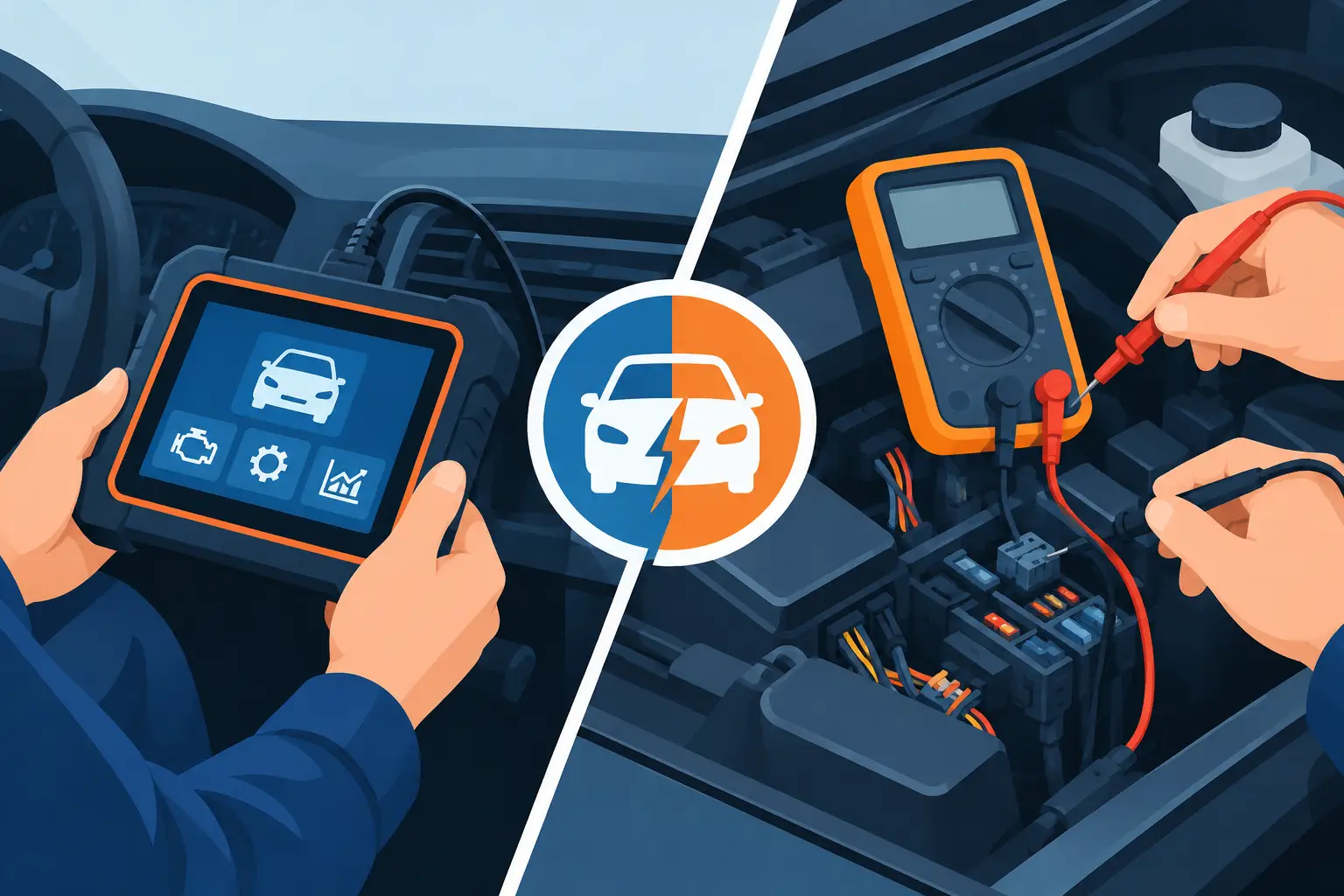
A check engine light comes on, a scan tool reports a code, and someone says the part named in that code must be bad. That is how expensive guesswork starts. In the scan tool vs electrical testing debate, the right answer is not one or the other. A scan tool tells us where to begin. Electrical testing tells us what actually failed.
For drivers in Mesa and the East Valley, this difference matters most when a vehicle has already had parts replaced without fixing the problem. A new sensor, module, battery, alternator, or fuel pump may be perfectly good, yet the original symptom remains. We will NEVER replace parts you do not need. Finding the root cause first is how a difficult repair gets done right.
What a Scan Tool Can Tell You
Modern vehicles communicate through computers. The engine control module, body control module, ABS system, airbag system, transmission controller, and other modules constantly monitor circuits and operating conditions. When one sees a reading or signal outside its expected range, it may store a diagnostic trouble code.
A professional scan tool can access those codes, along with valuable supporting information. It can show live sensor data, freeze-frame information captured when a code set, module communication faults, pending codes, readiness monitors, and sometimes bidirectional controls. A technician may command a cooling fan on, cycle an actuator, view wheel-speed data, or check whether a module is receiving information from another system.
That is powerful information. It can quickly narrow a no-start to a missing crankshaft signal, identify a module that is off the communication network, or show that one wheel-speed sensor is reporting an impossible speed. It also helps verify repairs after the work is complete.
But a code does not automatically identify a failed part. It identifies a condition the computer detected. Those are not the same thing.
Why a Trouble Code Is Not a Parts List
Consider a code for an oxygen sensor heater circuit. It may be tempting to install an oxygen sensor and call it done. Yet the sensor may be good. The actual fault could be a blown fuse, a corroded connector, a broken wire near the exhaust, poor power supply, a damaged ground, or a driver failure inside the engine computer.
The same principle applies to codes involving fuel pumps, throttle bodies, ignition coils, airbags, wheel-speed sensors, and body electronics. A code might say a circuit is open, shorted, high voltage, low voltage, or out of range. The computer usually cannot see whether the failure is inside the component, in the wiring, in a connector, at a ground point, or in the module controlling the circuit.
A scan tool can also point toward a symptom created by another problem. Low system voltage from a weak battery, poor battery connection, failing alternator, or bad ground can trigger a collection of unrelated warning lights and communication codes. Replacing every module that complained would be wasteful. Testing the vehicle's power and ground supply comes first.
Scan Tool vs Electrical Testing: How a Real Diagnosis Works
Electrical testing means checking the circuit under the conditions where it is supposed to work. This includes measuring voltage, ground quality, resistance when appropriate, current draw, voltage drop, signal patterns, and network communication. It requires a wiring diagram, proper test equipment, and the experience to interpret the results.
Voltage alone is not enough. A wire can show battery voltage with no load and still fail when the component is asked to work. Corrosion inside a connector or a partially broken wire can restrict current flow without looking obvious. That is why voltage-drop testing is so valuable. It exposes unwanted resistance in power and ground paths while the circuit is loaded.
For example, a starter may click but not crank. A scan tool may show no meaningful code at all. Electrical testing can determine whether the starter is receiving proper power, whether the ground path is sound, whether the control signal reaches the solenoid, and whether the battery voltage collapses under load. The problem may be the starter, but it could just as easily be a weak battery, damaged battery cable, poor engine ground, ignition switch issue, relay, or control-module command problem.
The goal is not to perform every possible test. The goal is to use the scan data and the vehicle's symptoms to select the next test that proves or eliminates a likely cause. That is paid professional diagnosis, not parts swapping.
Problems That Require More Than a Code Reader
Some issues are especially likely to be misdiagnosed when a shop relies only on codes. Parasitic battery drains are a prime example. A scan may reveal module activity or communication faults, but the technician still needs to measure key-off current draw, allow the vehicle to enter sleep mode, isolate the circuit, and determine what is keeping the vehicle awake.
Intermittent electrical faults also demand hands-on testing. A power window that works only sometimes may have a failed switch, worn motor, broken wire in the door jamb, damaged connector, or body control module issue. The fault may disappear when the panel is removed or return only on a hot Arizona afternoon. Test results have to be gathered carefully, not assumed.
ABS and airbag warning lights require the same discipline. A scan tool can identify the affected system and retrieve manufacturer-specific codes. Electrical testing confirms whether the problem is a sensor, damaged wiring, poor connector contact, clock spring, module, or a power and ground issue. These are safety systems. Guessing is not acceptable.
Module programming and replacement present another trap. A communication code does not always mean the module is defective. Before replacing a PCM, BCM, or other controller, the module's power, grounds, network circuits, and related inputs must be verified. If replacement is necessary, programming or configuration may also be required for the vehicle to operate correctly.
What Proper Electrical Testing Looks Like
A good diagnostic process begins with the customer’s exact complaint. Does the issue happen cold, hot, after rain, while turning, after the vehicle sits overnight, or only when multiple accessories are running? Those details direct the testing.
Next comes a visual inspection of battery terminals, fuses, harness routing, connectors, aftermarket accessories, and prior repair work. Many difficult problems are caused by damage that is easy to overlook: rodent-chewed wiring, corrosion below insulation, loose ground bolts, improperly installed alarms, or a connector that was never fully latched.
Then the technician checks scan data and performs targeted electrical tests. Depending on the fault, that may involve a digital meter, test light, amp clamp, lab scope, battery tester, pressure gauge, or network diagnostic equipment. A lab scope, for instance, can show a distorted crankshaft sensor waveform or a communication signal that a basic meter cannot capture.
Finally, the repair must be verified. Codes are cleared, systems are retested, and the original operating condition is duplicated when possible. If a vehicle arrived with a battery drain, it should be checked after shutdown. If it had an intermittent no-start, the charging and starting system should be proven under load. A repair is not complete because a code disappeared once.
When a Scan Tool Is Enough, and When It Is Not
There are times when scan data provides a clear direction. A maintenance reminder, a confirmed emissions monitor status, or a straightforward code with an obvious failed component can be handled efficiently. Scan tools are essential equipment, and no serious diagnostic shop works without them.
The need for electrical testing rises when the symptom is intermittent, multiple systems are involved, the vehicle has repeat codes after repairs, a fuse keeps blowing, the battery goes dead, or another shop has already replaced parts without success. It is also necessary whenever a code references a circuit rather than proving an internally failed component.
A low-cost code reader can be useful for a vehicle owner who wants basic information. It cannot replace a wiring diagram, a voltage-drop test, an oscilloscope, or years of pattern experience. Reading codes is the opening step. Diagnosis is the work required to prove the cause.
Village Auto Electric has been solving electrical and electronic vehicle problems since 1949, including the cases other shops refer out. Whether the issue is a no-start, warning light, battery drain, failed accessory, module concern, or unexplained electrical behavior, the standard should be simple: test it, prove it, and repair what is actually wrong.
If your vehicle has been collecting parts but not answers, bring the symptoms, the repair history, and any scan results you have. The next step should be a diagnosis that gives you a clear reason for the repair before you spend money on another guess.

Comments