


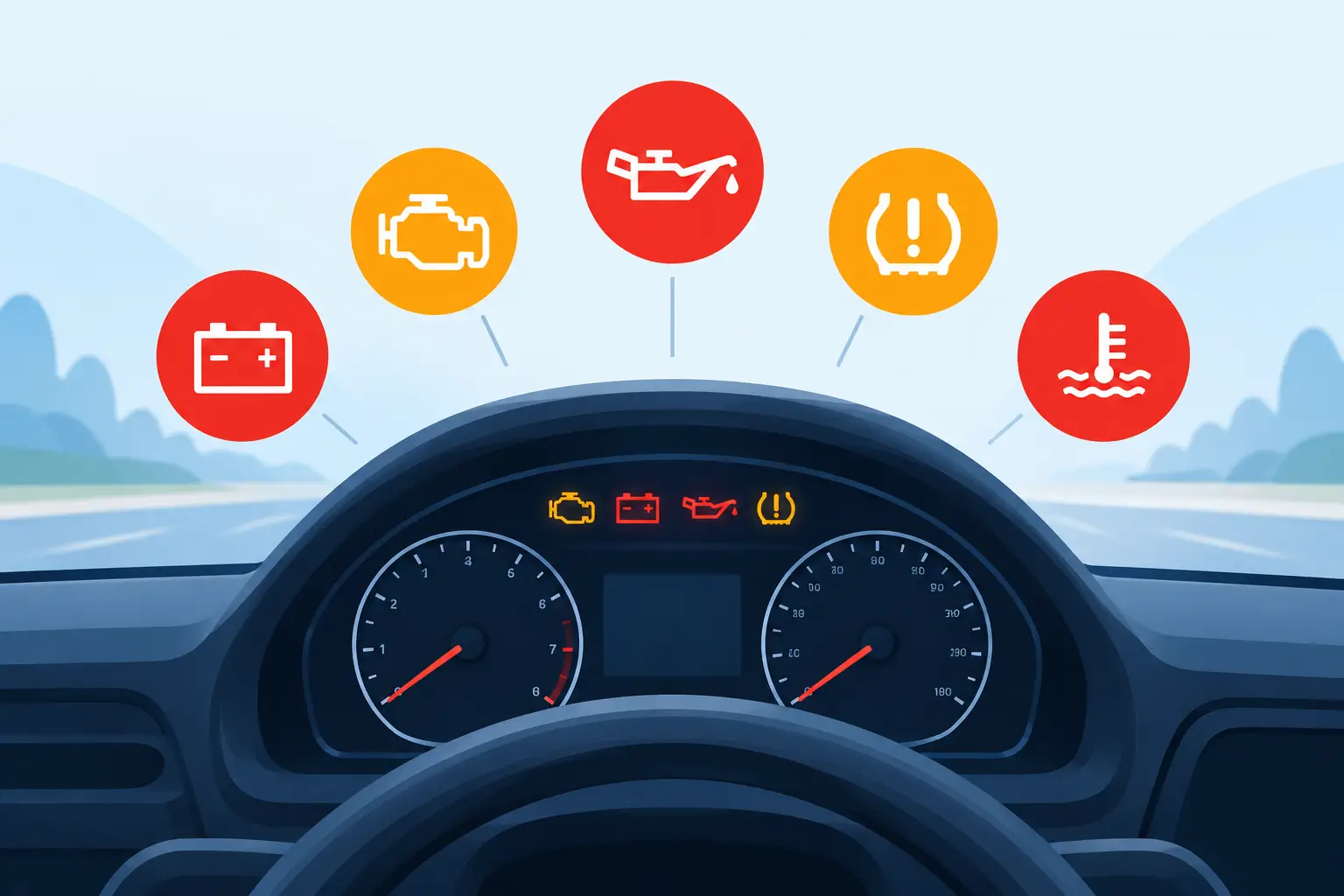
Top Causes of Dashboard Warning Lights Explained
A warning light can come on during the morning commute, disappear by lunchtime, and leave you wondering whether you have a real problem or a bad sensor. The top causes dashboard warning lights appear are not always obvious, especially on late-model vehicles where one electrical fault can affect several systems. The light is a signal, not a diagnosis. Finding the actual cause before replacing parts is what prevents wasted money and repeat repairs.
What the warning light color is telling you
Not every dashboard light carries the same urgency. Red lights generally indicate a condition that can cause immediate damage or create a safety problem. Low oil pressure, overheating, a charging-system failure, and a brake warning light deserve prompt attention. If the vehicle is overheating, has no oil pressure, or the brake pedal feels abnormal, safely pull over and shut it down rather than trying to make it home.
Yellow or amber lights usually mean the vehicle needs service soon, but the vehicle may still be drivable depending on how it runs and what light is on. The check engine light, ABS light, traction control light, tire-pressure light, and airbag light commonly fall into this category. A flashing check engine light is different. It often means an active misfire that can damage the catalytic converter, so do not keep driving it unnecessarily.
A light can also be caused by a temporary condition. A loose gas cap, low tire pressure after a cold morning, or a weak battery after the vehicle has sat may trigger a message. But clearing the light without testing the system only hides useful evidence. If it comes back, the vehicle is telling you the fault was never corrected.
Top causes of dashboard warning lights
Low voltage, weak batteries, and charging problems
Modern vehicles depend on stable voltage. A weak battery, failing alternator, loose battery connection, corroded cable, or poor ground can set warning lights for the engine, ABS, steering, airbag, transmission, and other modules at the same time. That does not mean every system has failed.
Low voltage can make modules communicate incorrectly or drop offline altogether. This is especially common when a vehicle cranks slowly, needs a jump-start, stalls at idle, or shows multiple warning messages after starting. In Arizona, extreme heat is particularly hard on batteries and can shorten their life without much warning.
The correct repair depends on test results. A battery may show acceptable voltage at rest yet fail under load. An alternator may charge at idle but fall behind with the A/C, blower motor, headlights, and rear defroster operating. Proper charging-system testing checks the battery, alternator output, voltage drop, connections, and vehicle draw. Replacing an alternator because a battery light came on is not a diagnosis.
Engine and emissions faults
The check engine light comes on when the powertrain control module detects a fault affecting emissions, engine operation, or a monitored component. Common causes include ignition misfires, failed ignition coils, worn spark plugs, vacuum leaks, fuel-delivery problems, oxygen sensor faults, EVAP leaks, and sensor wiring damage.
The trouble code is only the starting point. A code may identify a cylinder misfire, for example, but not tell you whether the cause is an ignition coil, spark plug, fuel injector, compression issue, wiring problem, or intake leak. Installing parts based on a code alone is how an inexpensive repair turns into a long list of unnecessary parts.
A steady check engine light with normal drivability still needs attention. A flashing light, fuel smell, rough running, loss of power, or repeated stalling calls for faster diagnosis. Continued driving can create additional damage and make the original problem harder to isolate.
ABS, traction control, and brake system faults
ABS and traction control systems share information from wheel speed sensors, the ABS module, brake switches, steering-angle sensors, and the vehicle network. A damaged wheel-speed sensor wire, failing bearing encoder, contaminated sensor, low system voltage, or module communication problem can turn on ABS, traction control, and stability-control lights together.
In many cases, the base hydraulic braking system still works when the ABS light is on. However, anti-lock braking and stability-control functions may be disabled. A red brake warning light can indicate low brake fluid, a parking brake issue, or a more serious hydraulic problem. If braking feels soft, pulls, grinds, or requires extra pedal travel, do not treat it as an electrical inconvenience.
An accurate diagnosis checks live wheel-speed data, wiring integrity, module communication, and the brake system itself. A scanner code can point the technician toward a corner of the vehicle, but it cannot prove the sensor, wiring, bearing, or module is the failed part.
Airbag and SRS system issues
The airbag or SRS light means the supplemental restraint system has stored a fault. It may involve an impact sensor, seat-belt pretensioner, passenger-seat sensor, clockspring, wiring connector, airbag module, or low-voltage event. When that light is on, part of the restraint system may not operate as designed in a collision.
SRS diagnosis requires the correct scan equipment and careful testing procedures. Airbag components should not be guessed at, bypassed, or tested with methods that can damage the system. A light that appeared after a battery replacement, seat repair, collision, water intrusion, or intermittent starting problem still requires a proper scan and circuit-level diagnosis.
Tire-pressure monitoring faults
A tire-pressure warning may simply mean one or more tires are low. Check pressure when the tires are cold and use the pressure listed on the driver-door placard, not the maximum pressure printed on the tire sidewall. Temperature changes can move the pressure enough to trigger the light.
If pressures are correct but the light remains on or flashes, the issue may be a failed TPMS sensor, damaged sensor during tire service, missing sensor identification, or a receiver and communication fault. Sensors have internal batteries and eventually fail. The practical repair is not always four new sensors - testing identifies which sensor or system component is actually at fault.
Wiring, grounds, water intrusion, and module communication
Some of the most frustrating warning-light problems are intermittent. The vehicle may behave normally at the shop, then show several warnings after rain, heat, a car wash, or a bump in the road. Damaged wiring, loose connectors, corroded grounds, rodent damage, water intrusion, and failing modules are common causes.
These problems need more than a quick code read. A technician may need to inspect wiring diagrams, test voltage drops, verify network communication, load-test a circuit, and monitor data while moving harnesses or recreating the conditions under which the fault occurs. This is where experienced electrical diagnosis saves money. The goal is to locate the failed circuit or component, not replace every module that happens to report a communication code.
What to do when a warning light comes on
Start by observing what changed. Note the exact light or message, whether it is red, yellow, steady, or flashing, and whether the vehicle has symptoms such as slow cranking, rough running, hard shifting, overheating, brake changes, or dim lights. If possible, take a photo of the dashboard before the message disappears.
Then use common sense about urgency. Stop driving for oil-pressure, overheating, serious brake, or charging warnings that are accompanied by obvious symptoms. For a steady check engine light or an ABS light, schedule diagnosis soon and avoid assuming the vehicle is safe simply because it still moves.
Avoid disconnecting the battery to reset the light before it is tested. Doing so can erase codes and freeze-frame data that help identify the conditions present when the fault occurred. It can also create new module initialization issues on some vehicles.
Why a professional diagnosis matters
Dashboard lights are designed to report faults, not to explain them. A parts-store code scan can be useful information, but it does not replace system testing. The same code can have multiple causes, and one electrical problem can trigger warnings in several unrelated-looking systems.
At Village Auto Electric, difficult warning-light cases are approached with paid professional diagnostics, circuit testing, scan data, and repair-first judgment. We will find the cause, explain what failed, and NEVER replace parts you do not need. That matters whether the issue is a simple battery connection or a vehicle network fault another shop has not been able to resolve.
A warning light is easiest to fix when it is treated as useful information, not an annoyance to clear. Pay attention to the color, symptoms, and timing, then get a clear diagnosis before a small electrical issue becomes a no-start, a safety concern, or an expensive chain of guesswork.

Comments